
Reading Lafayette County Release Status
A release record marks the end or change of one custody episode. For Lafayette County released inmates, it should show who was booked, when county control began, when it ended, how it ended, and what authority caused the change. The Lafayette County Sheriff’s Department runs the Detention Center and keeps the jail docket. That docket is the main local source after a name drops from current jail information. A court record answers a different question. It explains the legal action behind bond, dismissal, sentence, or another order, but may not show the exact time the person left the building.
“Released” does not always mean free from all custody. A bond or completed local term may send someone back to the community. A transfer to the Mississippi Department of Corrections, another county, the U.S. Marshals Service, or ICE closes the Lafayette booking while custody continues elsewhere. A hospital trip or court transport may not close the booking at all. The key question is simple: released from which authority? The answer determines whether the next proof comes from a court clerk, MDOC, another jail, a federal locator, or the Lafayette jail docket.
- Discharge
- The formal end of a stated custody or supervision term.
- Time served
- A release after the court credits enough time to satisfy the local custodial term.
- Detainer
- A request from another authority to hold or receive a person when local custody ends.
- Parole
- Conditional community release from prison under Board authority and MDOC supervision.
Lafayette County Release Types
The wording on the record matters. A bond release does not end the case. A dismissal resolves a charge only when the court file says so. Probation may be ordered with no state-prison stay, while Earned Release Supervision keeps a person under MDOC jurisdiction and in inmate status outside a prison. Transfers deserve special care because they can look like a release in the county system even when another agency takes control.
| Release type | What it means | Best next record |
|---|---|---|
| Bond or recognizance | The jail stay ends while the case remains open. | Jail docket, bond order, and court docket |
| Time served or sentence complete | The listed custodial term has ended, subject to any other hold. | Release entry and signed judgment |
| Dismissed or not guilty | The court outcome controls; the jail entry proves the custody exit. | Final court order plus release entry |
| Parole or ERS | Physical prison custody changes to supervised status; ERS is not full discharge. | MDOC inmate and parolee records |
| Transfer or detainer | Lafayette control ends but custody may continue. | Officer receipt and receiving-agency locator |
A record may use a code rather than plain words. Ask the Sheriff’s Department for the code key and the release warrant, court order, or receiving-officer receipt. Do not expand a Lafayette code with a definition borrowed from another county. If several charges share one booking, verify that every hold was resolved before describing a community release.
Lafayette County Release Record Fields
Mississippi jail-docket law calls for a complete history, not just a name and date. A useful Lafayette County release record connects the booking episode to the authority that ended it. Give the custodian a booking number and bounded date range when available. The following fields help distinguish release home from transfer and reduce the risk of joining two people with the same name.
| Field | What it shows |
|---|---|
| Name, aliases, and birth date | Identity for the specific booking |
| Booking number and booking date | The custody episode being checked |
| Arresting agency and cause | Which court or agency may hold the linked order |
| Release date and time | When county control ended, if both values were recorded |
| Release type and authority | Bond, time served, order, transfer, or another stated basis |
| Destination or officer receipt | Whether another agency received the person |
| Bond and fee data | Administrative facts tied to the booking, not the final case outcome |
| Booking photograph | An image tied to that booking, subject to lawful access limits |
The court disposition must be checked separately. A booking charge is an allegation at intake and can later change, merge, or be dismissed. Likewise, a release order date may precede the door-exit time while staff complete checks and paperwork. Ask what event each timestamp describes. Lafayette County publishes no routine release hour, so no exact time should be inferred.
Requesting Lafayette County Release Records
Lafayette County provides a formal public-record request process and a county request form. The County Administrator accepts the form in person, by mail, or through the email route printed in the current instructions. The office is at 300 North Lamar Boulevard, Oxford, MS 38655, with mail directed to P.O. Box 1240, Oxford, MS 38655. Published hours are Monday through Friday, 8:00 a.m. to 5:00 p.m., and the number is 662-236-2717.
- Identify the person and one booking. Supply the full name, date of birth if known, booking number, cause number, and a tight date range.
- Ask for existing records. Name the jail-docket entry, booking record, release date and time, release type, release authority, receiving agency, bond fields, and booking photograph.
- Request an electronic copy when available. Ask for all segregable nonexempt portions and a written citation for any withheld field.
- Compare the result with the correct court order. If the docket shows a transfer, continue with the receiving agency instead of treating the entry as release home.
The county states a seven-day response policy, a charge of $0.25 per copied page, and staff time based on the employee who performs the work. State law limits recoverable cost to actual cost at the lowest competent staff level. A cost estimate may come before production. Narrowing a request and choosing electronic delivery can reduce expense. For time-sensitive status, call the Lafayette County Detention Center at 662-234-6421 first, then obtain the written entry.
Note: An oral answer can guide the next call, but the jail-docket entry is the durable evidence of how Lafayette custody ended.
Lafayette County Release Record Law
The Mississippi Public Records Act, Miss. Code §§25-61-1 through 25-61-19, covers records and photographs made or received in public business. Section 25-61-5 provides inspection and copying rights. Under adopted procedures, an agency ordinarily produces or denies within seven working days. If it cannot, it must give a particularized written explanation, and without an agreed extension production may not exceed fourteen working days. A denial should cite the exact exemption, while nonexempt parts should be released after lawful redaction.
Two jail statutes are especially useful. Section 19-25-63 requires the history to state how a person was released or discharged and to identify the warrant or penitentiary officer receipt. Section 47-1-21 adds the discharge date and sentence or fee details. The current state retention schedule makes the jail docket permanent, keeps booking records for ten years after release, and preserves inmate case files for twenty-five years after release. A missing web result is therefore not the same as a missing public record.
Sealed, expunged, juvenile, victim, security, or investigative material may be restricted. Ask for the cited rule and all portions that can lawfully be separated.
Getting Home After Lafayette Release
The official detention-center page places the jail just west of Oxford Square and documents free visitor parking in front, with other free and paid parking nearby. That helps a family plan where to arrive. It does not identify a release door, a waiting area, or the hour when processing will finish. Call the detention center before leaving for a pickup and ask staff where visitors may wait without blocking jail operations.
Oxford–University Transit shows a Blue West route serving Square and Jackson Avenue geography on its live map. No reviewed official source verifies a stop at the jail door or a service meant for people leaving custody. Check the live route and confirm the nearest practical stop with transit staff. Transportation should never be used as proof that release occurred. The written Lafayette release entry and the jail’s current confirmation control that question.
Finding Lafayette County Released Inmates
Start with a custody ladder. Repeating a search in a current-inmate list cannot prove a past release because a released person normally drops from an active roster. Lafayette County has no verified official recent-release feed in the sources reviewed as of July 26, 2026. The permanent docket and agency-to-agency trail are therefore central, not secondary.
- Call the detention center and ask whether the named booking is active. If not, ask for the date, stated release type, and any receiving agency.
- Request the jail-docket and booking entry through the county process. Preserve the booking number and authority for release.
- Check the right court. Justice Court, Oxford Municipal Court, and Circuit Court handle different parts of Lafayette criminal matters.
- If the person entered state custody, search MDOC by name or MDOC number. Read Location and Tentative Release as separate fields.
- Check Mississippi SAVIN/VINELink for an agency-fed event and the parolee search for community parole supervision.
- Use BOP or ICE only when the docket or court file supplies a federal or immigration lead. Confirm the meaning with the receiving agency.
Contradictions are clues, not a reason to pick the newest screen. A court may sign an order before jail processing ends, VINELink may post after the booking file changes, and MDOC may recalculate a forecast. Match names, identifiers, booking dates, and source agencies, then ask the office that created the disputed field to clarify it in writing.
A name missing from current jail information may reflect release, transfer, delayed entry, a spelling mismatch, or a restricted record. Absence alone proves none of them.
Searching MDOC Lafayette Release Records
The official MDOC Inmate Search accepts a first and last name or an MDOC ID. It applies only after a person enters the state corrections system. Many people who bond out of the Lafayette County jail, remain pretrial, or complete a local term never receive an MDOC record. A failed MDOC search says little about a county booking.
| MDOC field | How to use it |
|---|---|
| Name or MDOC ID | Start the search, then confirm identity before opening details |
| Photo and descriptors | Help separate people with similar names |
| County and sentence date | Connect the result to a Lafayette conviction |
| Location and change date | Show the current state placement and recent movement |
| Tentative Release | A forecast that can change, not proof of an actual exit |
The official MDOC search form is shown below so its public inputs can be recognized before searching.
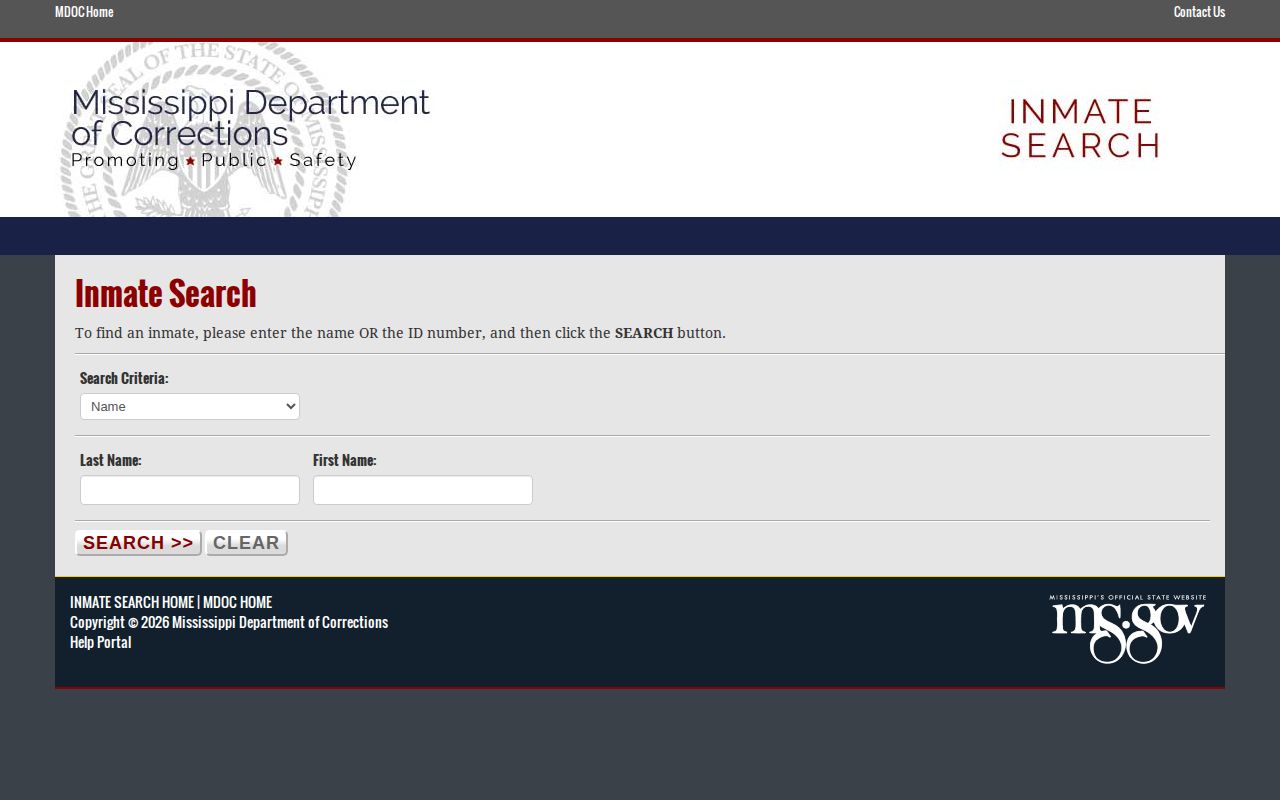
The image documents the interface, not any person’s Lafayette County status. After a possible prison exit, use the separate MDOC Parolee Search. A matching parolee record can show the county and supervising officer, but it does not mean the sentence has fully discharged.
Lafayette County Recent Release Limits
No official web-based current roster, 24-hour release list, or 72-hour release list was located in the official Lafayette County and sheriff sources reviewed as of July 26, 2026. No exact feed URL, refresh cycle, rolling window, or web-retention period can honestly be given. The Sheriff’s Department app announcement says “recent arrests,” plus alerts, tips, social feeds, and a local registry. It does not promise recent releases.
A historical November 2021 Rule 8.5(c) jail list contains subject, charge, birth date, booking number, booking date, and a Release Date column. Yet the archive explains that these sheriff-supplied lists were prepared for court terms, and the located document showed then-current people with blank release cells. It is not today’s release feed. For a same-day picture, use the jail call and written docket route described on the Released Last 24 Hours page.
Lafayette Release Court Routing
Lafayette has a distinct court-routing issue. Justice Court handles county and University misdemeanors and initial felony matters, including felony charges that arise through Oxford. Oxford Municipal Court handles relevant city matters. Circuit Court and its clerk keep final felony outcomes. That means the detention-center release record can be county-held while the order that explains it belongs to one of several court systems.
Use the cause number and arresting agency to choose the court. Ask for the bond order, sentencing judgment, dismissal or nolle prosequi, revocation, and any order showing completion. The county’s public-record landing page still mentions paid Delta access, but the Chancery Clerk and old Delta query indicate that current filings moved to Mississippi Electronic Courts in July 2023. Chancery Court is generally not the criminal-release route. A stale Delta result should not be treated as a complete case search.
Lafayette Release Supervision Programs
Mississippi splits parole authority from supervision. The State Parole Board decides parole, while MDOC computes eligibility and its Division of Community Corrections supervises people in the community. Probation comes from a court and can occur without a prison term. ERS, or Earned Release Supervision, keeps a person in inmate status under MDOC jurisdiction outside a prison. These are not interchangeable labels. Lafayette parole and probation verification uses the parolee search, the local office, court records, and Board or MDOC records when no public result resolves the question.
Local detention programming adds Lafayette detail. A 2022 county article reported thirteen participants in a state-approved alcohol and drug program and said many planned continued treatment after release. An earlier facility update described video kiosks, electronic legal access, and virtual hearings while calling GED and treatment items plans. Dates matter. Those articles do not prove every plan now operates or that any named person took part.
Federal and ICE Lafayette Transfers
Federal tools belong late in the Lafayette search path because no local federal prison, ICE detention center, or verified ICE contract jail was found. Use them only when a Lafayette docket or court record names a federal detainer, U.S. Marshals transfer, or immigration handoff. A county entry reading “released to ICE” describes release from county control and continued immigration custody.
The BOP locator can show a release date and “Released” or “Not in BOP Custody.” Those labels establish only that BOP no longer holds the person. ICE’s Online Detainee Locator uses an exact A-number and country of birth, or exact name and country of birth with other inputs. It covers current detainees and a limited recent-release period. A no-result can stem from matching rules, age, timing, or coverage. U.S. Marshals custody has no comparable public release locator, so the federal court docket and agency record route remain important.
Lafayette Release Lookup by Custody
Each system proves a different event. Match the source to the custody that may have ended, then reconcile any conflict with the agency that created the record.
| Situation | Primary source | Key limit |
|---|---|---|
| Current Lafayette booking | Detention Center status call | Current status is not a historical release record |
| Completed county booking | Permanent sheriff jail docket | Pair with court outcome and any receiving agency |
| State custody or forecast | MDOC inmate record | Tentative Release may change |
| Community parole | MDOC parolee search and local office | Supervision is not full discharge |
| Federal custody exit | BOP locator and federal docket | BOP exit does not clear other holds |
| Immigration transfer | County receipt and ICE locator | County release can be continued ICE custody |
Use a retrieval date for live results. MDOC details, VINELink events, app features, and locator statuses can change. A saved agency response, signed court order, or jail-docket entry has more value for a past Lafayette release than an undated screen capture.
Lafayette Detention Center Changes
A May 2026 county funding announcement describes the detention center as more than thirty years old and reports an average daily population of about 150. It says $5 million in state support is shared with a Communicare project and is planned for medical and observation space, security and door-control computing, plus electrical and plumbing work. This is an announcement, not a completion report.
The facility context can help explain why a live interface or processing practice may change. It does not alter the permanent docket duties or prove when any individual left custody. Staff assignments can change as well. Confirm the current jail administrator and operational directions before relying on an older county page.
Lafayette County Release Facilities
The Lafayette County Detention Center is the only verified local detention facility in the reviewed official sources. Oxford police defendants are directed there for a medical intake review, so there is no separate Oxford municipal-jail search path. The county jail docket records how the local episode ended, while the correct city, justice, or circuit court explains the order.
The Mississippi Department of Corrections is a statewide custody and supervision system, not a prison located in Lafayette County. When the jail docket documents an MDOC transfer, use the MDOC inmate search during state confinement, the parolee search after parole, and state records for ERS or full discharge. Federal and immigration locators are conditional receiving systems, not local facility pages.