
Lafayette Parole and Probation Types
Mississippi assigns two agencies different roles. The Mississippi State Parole Board decides whether to grant or revoke parole. The Mississippi Department of Corrections, or MDOC, calculates eligibility and supervises people in the community. Lafayette County probation also runs through MDOC community corrections, but its legal source is a court judgment rather than a Board grant. That split matters when a record is checked. A Board action explains parole authority, while the parolee record and local office describe current supervision.
Parole is conditional release from state prison before the sentence fully ends. Probation is court-ordered supervision and can replace incarceration, follow a suspended sentence, or begin after a local jail term. Earned Release Supervision, known as ERS, is different again. A person on ERS may live outside prison but retains inmate status under MDOC jurisdiction. None of these labels means full discharge. A discharge is the formal end of the relevant custody or supervision term.
| Status | Who authorizes it | What the record establishes |
|---|---|---|
| Parole | Mississippi State Parole Board | Conditional community release from a state prison term |
| Probation | Sentencing court | Community supervision that may exist without prison |
| ERS | MDOC under state law | Community placement while the person remains an inmate |
| Discharge | Agency or court with authority | End of the stated custody or supervision obligation |
- Absconder
- A person reported as not complying with required supervision contact or location rules.
- Revocation
- An official decision ending community release and potentially returning the person to custody.
- Flat Time Date
- A date shown on an MDOC parolee detail; it must be read with the current supervision status.
Verify Lafayette Post-Release Supervision
The official starting point is the MDOC Parolee Search. It accepts a name, MDOC ID, city, or county. A useful match may show a photograph, MDOC number, Lafayette County, a supervising officer, and Flat Time Date. Match more than a name. A common name can return the wrong person, while the county field may describe supervision or case data rather than the jail where an earlier booking occurred.
The parolee search is evidence of present post-prison parole supervision, not a full history of every Lafayette County release. A probationer may have no prison release at all. Likewise, a person who bonded out of the Lafayette County Detention Center will not gain an MDOC record unless the state corrections system later becomes involved. The Lafayette County released inmate search explains how the jail docket and court result establish that earlier custody event.
- Search the person by full name or MDOC number. Use city or county only to narrow a broad result set.
- Open the closest match and compare the photo, date of birth, MDOC ID, county, and other identity details.
- Read the supervision label exactly. Do not turn probation, parole, or ERS into another status.
- Use the named supervising officer and Lafayette office when the live record needs clarification.
- Check the sentencing court or Board record if the issue is legal authority, a violation, or final discharge.
The official search screen shows the fields available before a Lafayette County parole lookup. View the MDOC parolee search source before comparing a match.
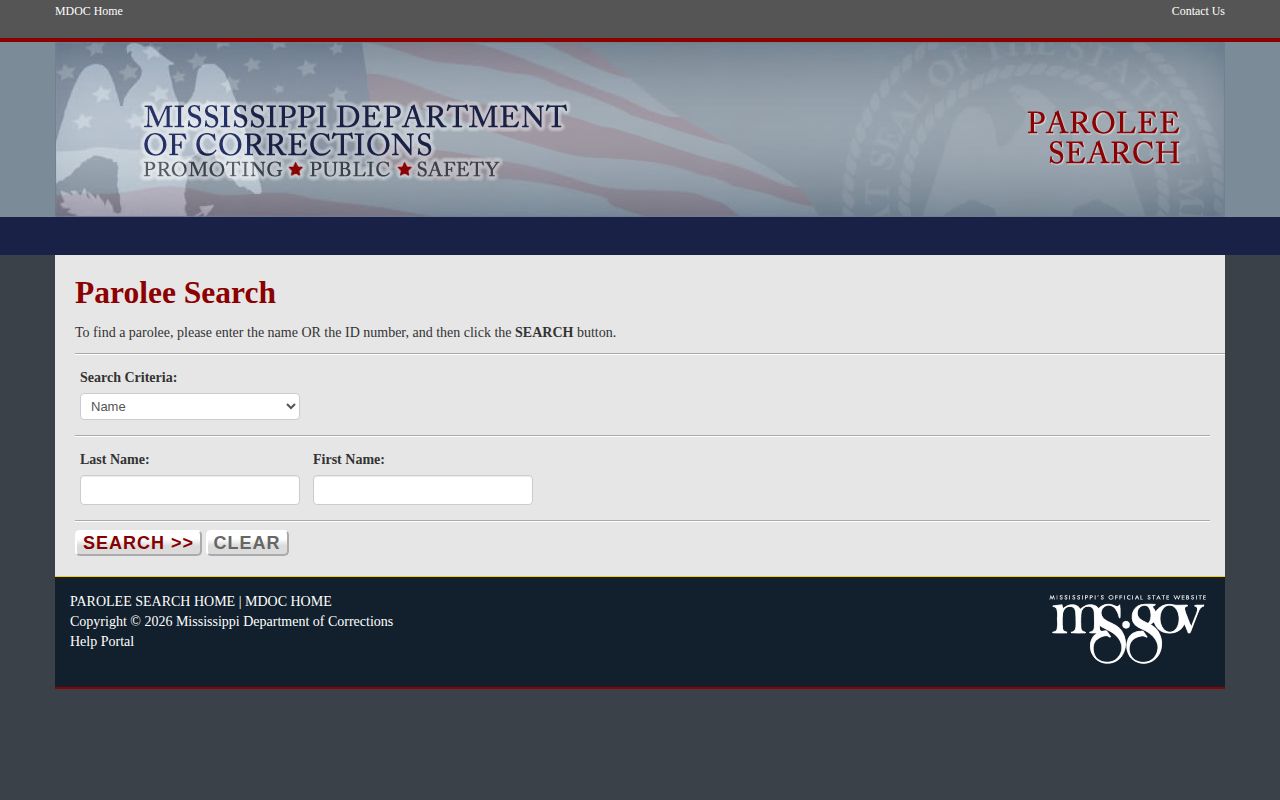
The screen supports a focused identity search, but the returned agency record and direct office confirmation remain more important than the form itself.
Note: A probation search result does not prove that the person was once released from a Mississippi state prison.
Lafayette Probation Office Records
The Lafayette Probation & Parole Office is the local MDOC contact for supervision assigned in this area. Call with the person’s full name and MDOC number when available. Ask whether the office can confirm the public supervision status, identify the right public record, or explain how to submit a formal records request. Staff may limit personal case details, and the office should not be asked for a private residence.
Lafayette Probation & Parole Office2627 West Oxford Loop, Suite F
Oxford, MS 38655
Phone: 662-234-9555
Fax: 662-234-7435
The manifest capture comes from the official Lafayette supervision-office listing.
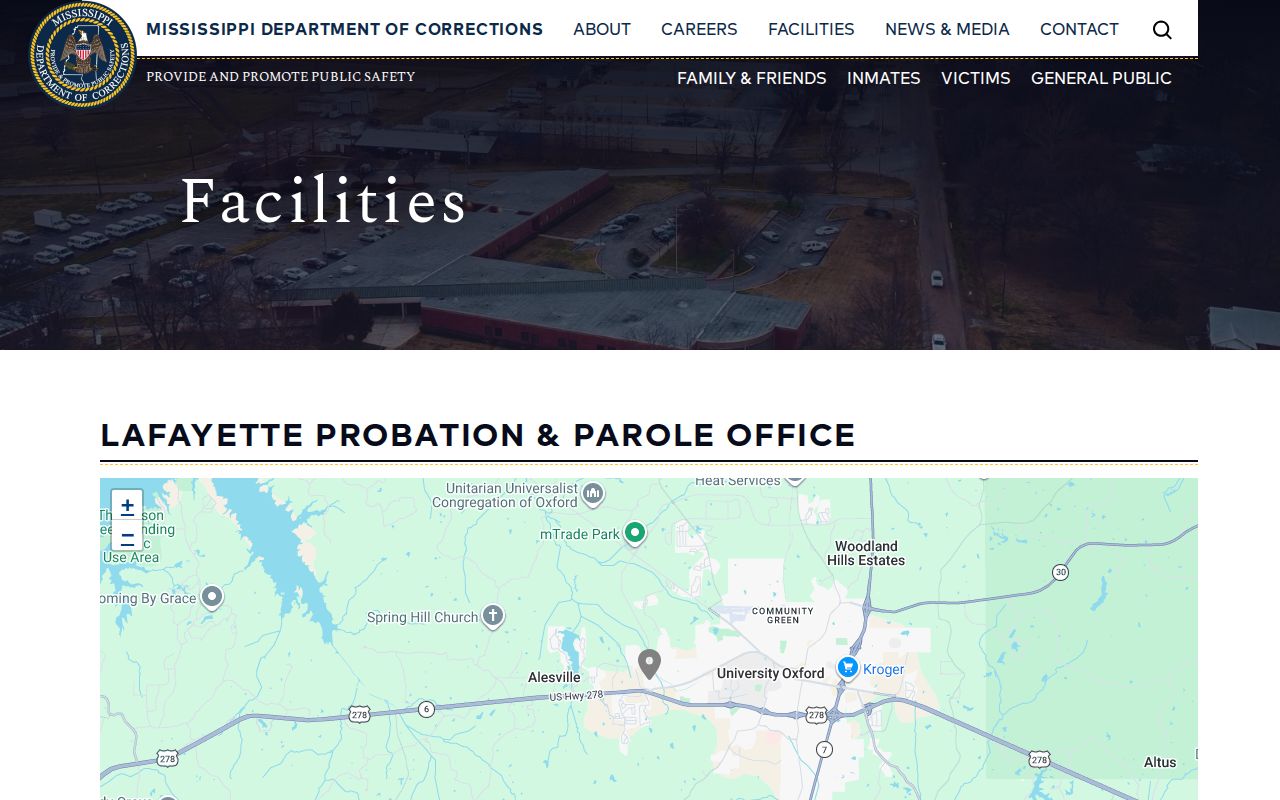
That office page confirms the local route for a Lafayette County supervision question; it does not replace the person-specific parolee record or court order.
Lafayette Parole Hearing Records
The Parole Board has exclusive authority to grant and revoke parole. Miss. Code §47-7-3 and Mississippi Administrative Code Title 29, Part 201 govern the process. Eligibility is personal to the sentence and offense. Rule 3.3 allows some qualifying initial-eligibility cases to proceed without a hearing only when its case-plan, victim-hearing, discipline, condition, and discharge-plan requirements are met. Violent offenses under §97-3-2 require a hearing. No single fraction or expected date applies to everyone.
Hearings are closed to the public under Rule 2.1. Board minute books preserve actions and reasons under Rule 2.4, and decisions go to the person and registered victims or family. Terms such as grant, denial, deferment, rescission, and revocation have distinct meanings. A grant does not prove the person left prison that day because an approved plan, residence, detainer review, and release processing may remain.
No public individual calendar was found. The official sources reviewed through July 26, 2026 did not provide an individual hearing docket, published cadence, or public decisions/results search.
Use the Board rules, the MDOC and Board GovQA portal, the offender and parolee records, and Mississippi SAVIN. Historic Board minutes from 1942 through 2009 do not supply a current schedule. A custody status should never be used to guess which Board action occurred.
A focused records request should identify the person, MDOC number, decision or eligibility period, and the specific Board action sought. Ask for an existing minute-book action or releasable reason rather than asking the agency to create a narrative. Release to people outside the offender and registered victim or family channels is case-by-case, so the agency may withhold or limit some material. Preserve the written response and describe only the action it actually returns. If the result says deferment, rescission, or revocation, do not shorten it to denial or release.
Lafayette Supervision Violation Checks
No official public Lafayette County absconder or warrant list was found in the reviewed sources. That negative finding prevents a dangerous shortcut. Silence on a local webpage does not mean there is no warrant, violation report, or return-to-custody action. An absconder label means the supervising agency reports lost contact or noncompliance. It is not itself a new conviction.
Mississippi SAVIN can send events that include return to custody and absconding from supervision when a participating agency supplies the change. An MDOC parolee record or the named officer may give the current status. The court docket can show a probation revocation order, while the Board record addresses parole revocation. When those sources disagree, use the most recent agency record and ask the originating office to explain the update. Record the date of each check because live systems can refresh at different times.
Common supervision conditions can include regular reporting, approved travel or residence, payment terms set by the court, and compliance with case-specific orders. The signed order controls. General conditions cannot reveal the terms imposed on one person. If a violation causes custody, the jail or MDOC record must still identify which authority received the person.
Note: A delayed SAVIN event is a lead to verify, not proof that Lafayette County supervision remained unchanged.
Lafayette Release Treatment Path
Lafayette County has a documented local treatment link, not a generic promise of reentry services. A 2022 county article on the jail alcohol and drug program reported thirteen participants and said many planned to continue treatment after release. The date is important. It shows a local transition path at that time, but it does not establish current enrollment, present eligibility, or the terms of supervision for a named person.
An earlier county correctional facility update documented video kiosks, electronic legal access, and virtual hearings. It described GED and treatment items as plans. Those planned items should not be recast as services now in place. For current program status, ask the Lafayette County Detention Center or the supervising office. For an individual, the signed release plan and current supervision record control.
Continued treatment may be part of a release plan, but participation does not by itself identify parole, probation, or ERS. The source of authority still matters. A Board action points to parole, a court judgment points to probation, and MDOC records explain ERS. This local program history helps frame a transition without blurring those legal tracks.
Lafayette Supervision Discharge Records
Supervision ends through an official discharge or other authorized action, not merely because a person stops appearing in a search. Ask for the discharge document, current MDOC status, or final court entry tied to the correct cause number. A Flat Time Date can help interpret a parolee record, but it should not be treated as a stand-alone certificate. If a record disappears, possible causes include system timing, a name mismatch, restricted access, or actual discharge.
MDOC records are the main source for state parole and ERS. The sentencing court holds the probation judgment and later modification or discharge order. The Board maintains its parole actions. Mississippi SAVIN is best for timely changes, while the durable record comes from the agency that created the action. This layered check answers whether Lafayette County supervision is active, what type it is, and whether it has formally ended.
A state prison exit and a Lafayette County jail release are separate events. If the person moved from the detention center to MDOC, the county docket proves the handoff and the state file controls the later parole or discharge. If probation began without prison, describe it as court supervision. Precise labels keep the custody history accurate.
When the public parolee entry and a court file appear inconsistent, compare the cause number, sentence date, MDOC ID, and retrieval date. One record may concern a newer case or a different supervision term. Ask the court to correct a judgment or docket error and MDOC to correct a state status error. Written corrections should be kept with the older result because downstream public systems may take time to refresh.