
Lafayette VINELink Release Coverage
The state service is Mississippi SAVIN using VINELink. Participating county booking systems and MDOC send changes to it. Documented notice types include release from custody, transfer, return to custody, escape, and absconding from supervision. For Lafayette County, that makes the channel useful when someone leaves the county jail’s current-custody picture or moves into state custody.
Coverage does not turn every event into the same kind of release. A county jail release to the community differs from a transfer to MDOC. A state prison release to parole differs from full discharge. An absconding event concerns supervision, not the end of a sentence. Read the agency name, status wording, and event together. Then use the Lafayette sheriff’s docket for a county event or MDOC for a state event.
The state’s official page explains SAVIN coverage and support options. See the Mississippi SAVIN source before interpreting the alert choices.
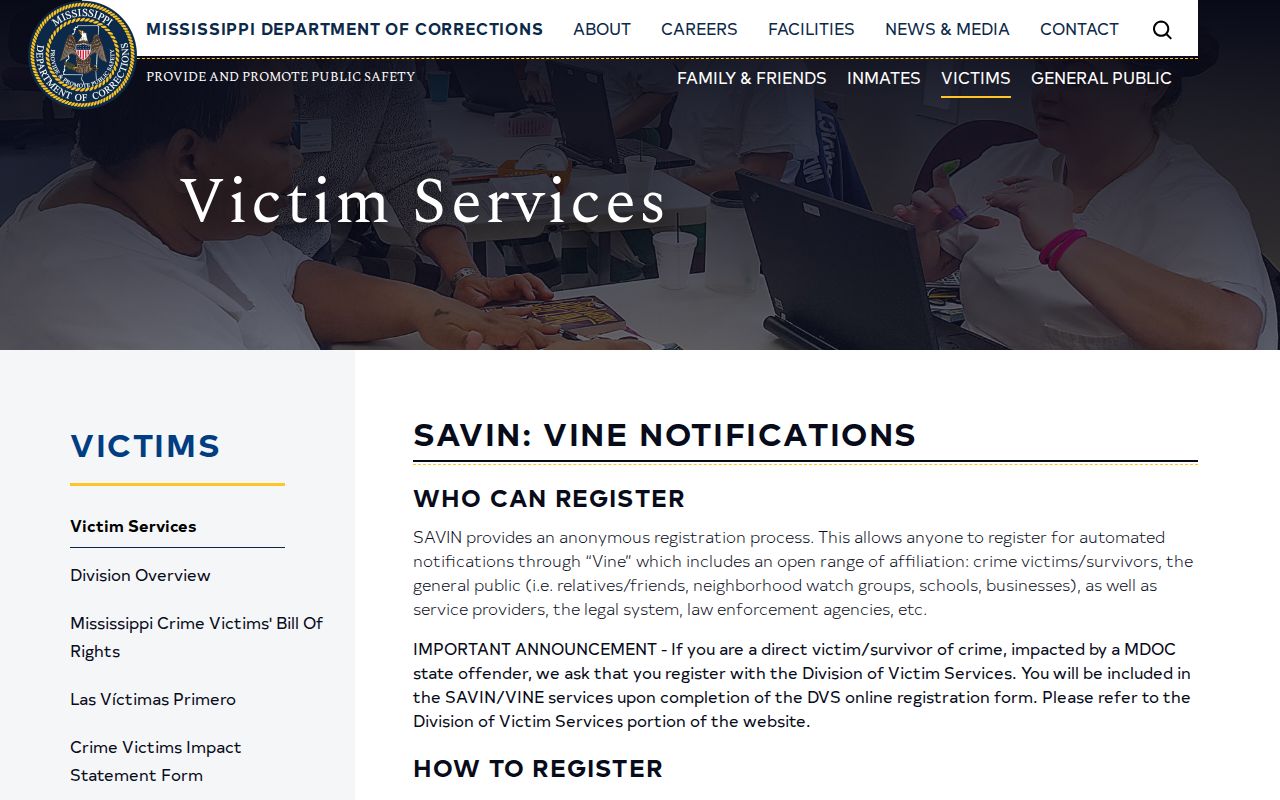
The captured page identifies the state notification layer, while the person’s matched record identifies which participating agency reported the event.
Search Lafayette VINELink Inmate Records
Open the Mississippi VINELink page and search for one person. Use the name or available ID criteria. Spelling matters. If several records look alike, compare the identifiers and custody agency before opening or saving a match. A result tied to MDOC should not be described as the Lafayette County jail record, even if the underlying conviction arose locally.
A no-result proves little. The name may be entered differently, the event may not have reached VINELink, the source record may have protected access, or the person may be in a system outside the service. Repeat the check with supported identifiers and confirm the likely custody agency. The Lafayette County released inmate search path adds the sheriff docket, court result, and receiving-agency record when VINELink is silent.
- Select Mississippi and open the person-search form.
- Enter the full name or available agency identifier. Try supported name forms when spelling is uncertain.
- Compare each result’s identity details and custody agency. Do not choose by name alone.
- Open the matched record and preserve the exact status and agency wording.
- Record the date and time checked, then confirm any release or transfer with the reporting agency.
The live interface shown in the manifest comes from the official Mississippi VINELink search.
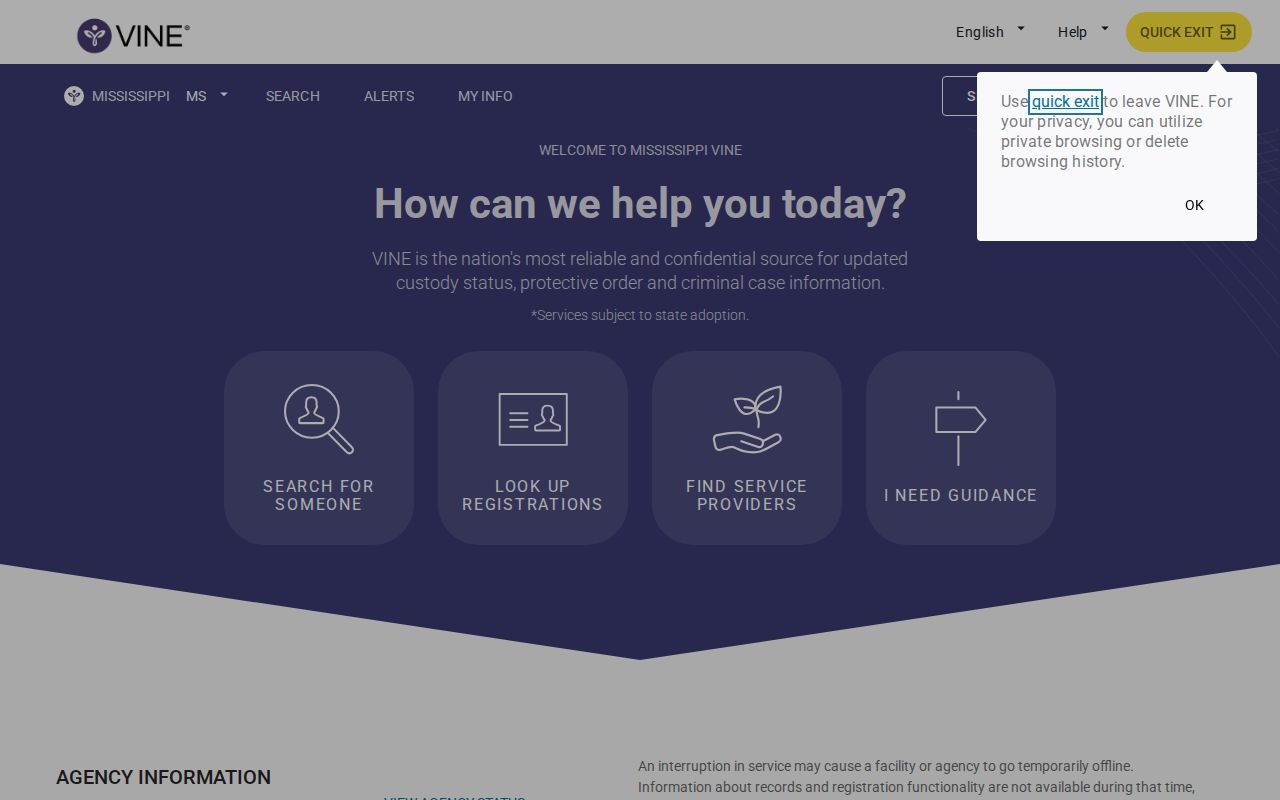
The form supports a specific-person search and registration flow. It is not a countywide recent-release list or a certified archive.
Lafayette VINELink Release Fields
The fields available can vary by participating record. Research confirmed name or ID matching, the custody agency and status sent by that agency, and selectable notification methods. A field that does not appear should not be guessed from another state’s interface. Likewise, a date shown as a future estimate is not an actual door-exit time unless the source labels it as an occurred release event.
| Field or event | How to read it |
|---|---|
| Name or ID | Identity key that must be compared with the source agency record |
| Custody agency | The jail or state authority that supplied the event |
| Custody status | Agency-fed state such as custody, release, transfer, or return |
| Release notice | Timely report of a source-posted event, not a certified discharge record |
| Transfer notice | End of one agency’s custody with possible continued confinement elsewhere |
| Alert methods | Phone, text/mobile, or email choices offered for that record |
A released result needs confirmation. Ask the Lafayette detention center for the county jail-docket entry or MDOC for the state release record that produced the alert.
A jail docket can identify how a person was released or discharged and whether another authority received the person. An MDOC discharge record distinguishes parole, ERS, and full discharge. VINELink is faster for notice, but those records are stronger for the lasting custody history.
Note: A transfer alert marks a custody change and should not be described as a return to the community.
Register Lafayette Release Notifications
Registration begins from the matched person, not from a general list. Choose the notification option offered on that record. Available delivery can include telephone, text/mobile, or email. The system may ask for a four-digit notification PIN. That PIN is used to acknowledge or manage a notice. If an account is created, a separate six-character code may arrive by text or email to confirm the account.
Keep the PIN in a secure place. It is not the person’s offender ID. Entering the wrong contact detail or losing access to the chosen method can prevent a useful alert. Options can vary by record, so follow the live Mississippi flow rather than assuming every method appears. Anonymous registration is available, while direct victims of MDOC offenders also have a Division of Victim Services route.
- Open the correctly matched person record.
- Select Register or the available notifications control.
- Choose each offered event and delivery method needed.
- Enter the phone, mobile, or email detail with care.
- Create the four-digit PIN when prompted and save the registration.
- Complete any separate account confirmation sent by text or email.
Registration should happen before the expected event. A notice cannot serve as a reliable archive if no registration existed when the agency posted the change. Save the matched agency and record identifiers so support staff can locate the correct registration if a notice fails.
Lafayette Transfer Alert Continuity
Lafayette County has a useful channel-specific feature when custody moves from the detention center to the state system. Mississippi SAVIN’s Registration Link can follow a registration into state or another participating custody. That continuity matters because leaving the Lafayette County Detention Center may be a transfer, not community release. A person can vanish from county information while remaining confined under MDOC.
When a transfer notice arrives, note the sending and receiving agencies. Search the receiving system after allowing for intake time. For MDOC, use the state Inmate Search and read Location, Entry Date, Location Change Date, sentence data, and Tentative Release separately. During transport or intake, the county entry and state record may not update at once. Call both agencies instead of treating the gap as freedom.
If the person later leaves prison on parole, the MDOC parolee search and Lafayette Probation & Parole Office can verify supervision. ERS must remain labeled as inmate status under MDOC jurisdiction. Full discharge needs the state record. This channel sweep keeps the alert tied to the correct stage of custody.
Registration continuity also depends on the matched record. A new agency ID, changed name form, or separate booking can create another result instead of updating the old one. Review the agency and identifiers after each handoff. If the Registration Link does not appear to follow the person, contact SAVIN with the old and new agency references. Do not register against a similar name merely to restore alerts. A wrong match can produce notices about someone else and leave the intended custody change unseen.
Lafayette SAVIN Alert Support
Mississippi provides several SAVIN support routes. Call 601-359-5759 during business hours, 1-888-9-MSSAVIN around the clock, or TTY 866-847-1298. Have the matched person, reporting agency, registration method, and time of the expected event ready. Do not share more personal data than support needs to locate the record.
If an expected notice does not arrive, first check the saved contact detail and PIN. Then confirm that the record still offers the event and method selected. Ask the originating agency whether it posted the release, transfer, or return event. A support call can address registration, while the sheriff or MDOC controls the underlying custody data.
Separate the notification service from the Mississippi Sex Offender Registry. The registry covers only qualifying registrants and has its own person and geographic searches. It is not a general released-inmate list. A registry match may remain after incarceration, but it does not establish the Lafayette release date or reason.
The registry and SAVIN also use different correction paths. A VINELink custody error belongs first with the jail or MDOC unit that sent the event. A registry error goes to the Mississippi registry office at MSOR@dps.ms.gov or 601-987-1540. Fixing one source does not guarantee that the other will change at once. Keep the record ID, agency name, retrieval time, and written correction so each office can trace the exact entry.
Direct victims of MDOC offenders can also use the Division of Victim Services and its notification form. That route is distinct from a general anonymous VINELink registration. The form can preserve a direct service relationship, while VINELink supplies selectable electronic notice. Use the channel that fits the live record and contact SAVIN support when it is unclear which registration remains active after a transfer.
Lafayette VINELink Release Limits
VINELink does not cover a federal Bureau of Prisons release. If the Lafayette jail docket names a federal receiving authority, use the federal court record and later the BOP locator. A BOP “Released” result means only that BOP no longer holds the person. U.S. Marshals custody has no public person-by-person release locator like VINELink.
Immigration custody also needs its own path. No official source reviewed identifies the Lafayette jail as an ICE contract facility. Use ICE’s locator only when a real detainer or transfer entry points there. A county transfer to ICE is not a community release, and a missing ICE result can reflect exact-match, age, or time-window limits.
Data lag is the core VINELink limit. A court may order release before jail processing ends. The agency may post an event after the physical change, or a registration may not carry across a nonparticipating system. For a Lafayette County event, call the detention center at 662-234-6421 and request the permanent jail-docket entry. For a state event, check MDOC and its supervision record. Those steps turn a timely alert into a verified release history.
Save alerts with context. The useful record includes the full agency label, person identifier, event wording, delivery time, and the date the source was checked. A screenshot without those facts can become misleading after a return to custody or later transfer. If two channels conflict, preserve both timestamps and ask the source agencies to reconcile them. The newest alert is not always the most complete record.
For a correction, start with the office that created the disputed fact. The sheriff controls the Lafayette booking and release entry through the county’s published record process. MDOC controls its incarceration and supervision fields. VINELink distributes what participating agencies send, so support may help trace an alert without having authority to rewrite the source record. After the source confirms a fix, allow time for the notification interface to refresh and check the matched record again.
Note: The absence of a VINELink match never proves that a person has been released or discharged.