
Lafayette Projected Versus Actual Release
A projected release date is a forecast based on the sentence data and rules known at the time of calculation. MDOC uses the exact public label Tentative Release. It may also calculate parole eligibility, ERS, tentative discharge, and maximum release dates inside its system. Those dates answer different questions. A future estimate does not prove that the person has left custody.
An actual release is an event recorded after the custody change. It should identify the date, type, authority, and any receiving agency. A person can reach a tentative date and remain confined while a detainer, discharge plan, or other required processing is resolved. MDOC says parole and ERS dates are not guaranteed, and its FAQ reports that release processing may take 30 to 45 days. A discharge certificate is required before the state release is complete.
Scheduled is not actual. Treat MDOC’s Tentative Release as a forecast until the live location, discharge record, and receiving or supervision record confirm the event.
A Lafayette County pretrial booking has no sentence-based projected date. Its end depends on bond, dismissal, a court order, transfer, or later sentence. The county jail docket and correct court file answer that question. Applying state-prison arithmetic to a person who has not been sentenced creates a date that has no legal basis.
Find Lafayette Inmate Release Dates
Start with the authority that holds the person. For a state prisoner, use the official MDOC Inmate Search. It accepts first and last name or an MDOC number. Match identity before opening the details. The record can include a photograph, ID, Entry Date, current Location and Unit, Location Change Date, sentence count and total, offense, county, sentence date, and Tentative Release.
County of conviction helps match the right sentence, but it does not prove where the person is confined. A Lafayette detainee who bonds out or serves a local term may never enter MDOC. For a county jail sentence, call the Lafayette County Detention Center at 662-234-6421 and ask for the sentence computation, credited time, holds, and signed release authority. The relevant court judgment supplies the sentence structure.
- Identify county jail, MDOC, federal, or another custody system before looking for a date.
- Match the person with a booking number, MDOC ID, date of birth, cause number, and sentence details where available.
- For MDOC, read Location and Tentative Release as separate fields. One is present custody; the other is a forecast.
- For a Lafayette jail term, request the court judgment and jail computation rather than applying MDOC rules.
- Check for concurrent or consecutive terms, jail credit, mandatory portions, detainers, and a pending Board action.
- Confirm close to the date with the holding agency and obtain the actual release or discharge record afterward.
A manifest capture documents the MDOC detail layout and Tentative Release label.
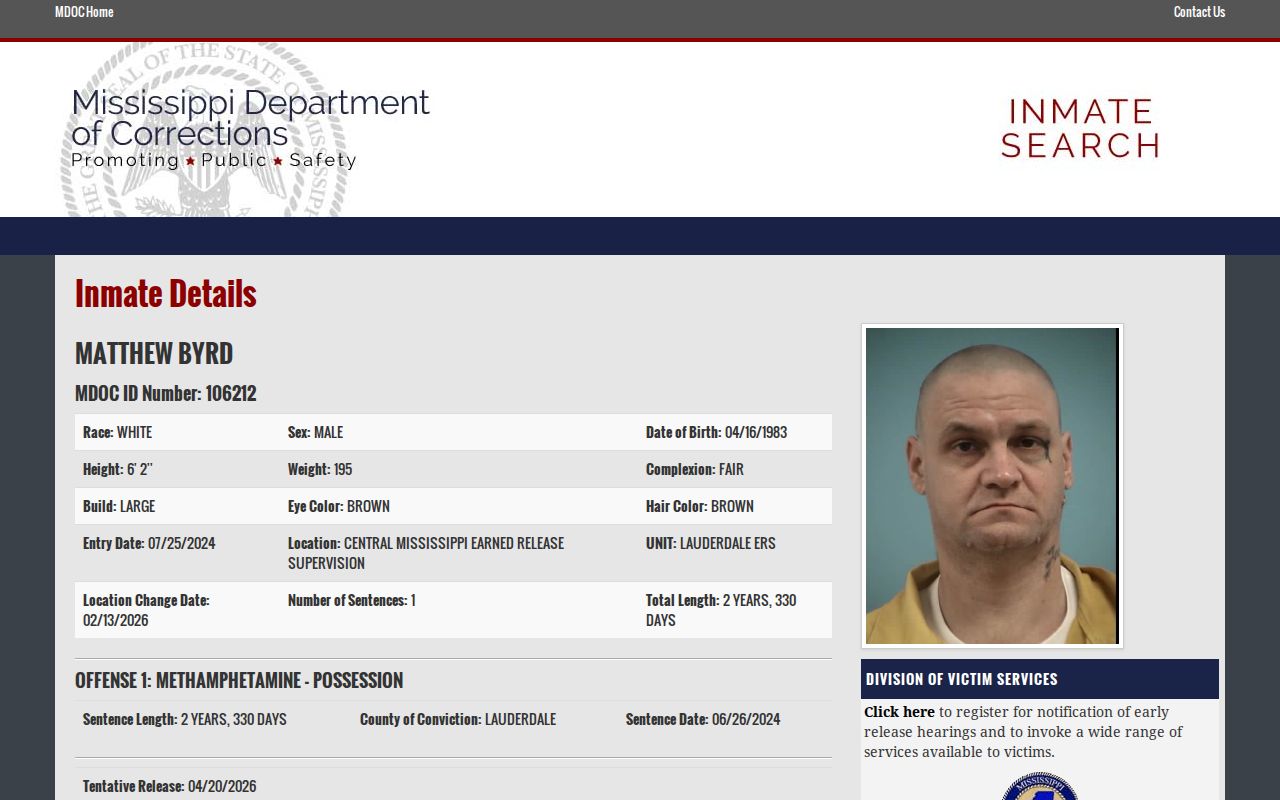
The example shows how the state presents the field. It is interface evidence only and does not identify a Lafayette County person or prove a current release.
Note: An unsuccessful MDOC search says little about a Lafayette County booking that never entered the state prison system.
Lafayette State Release Calculations
A reliable MDOC calculation begins with the signed sentence and sentence date. Presentence jail credit must be tied to the correct cause number. Concurrent terms run at the same time; consecutive terms run one after another. Mandatory portions, offense dates, and detainers must be identified before earned time is considered. A public Tentative Release value is the result of this work, not enough raw data to recreate it from scratch.
Verify each input against its source. The court supplies the judgment and later correction orders. The county jail record process supplies confinement dates and the county handoff. MDOC applies the state computation and maintains discipline, classification, and earned-time data. Another agency supplies its detainer. When a date looks wrong, send the supporting order or booking detail to the office that owns the disputed field. A general request to recalculate without identifying the error can miss the actual cause of the difference.
Miss. Code §47-5-138 is the core earned-release statute identified in the research. For many qualifying sentences imposed for offenses after June 30, 1995, the familiar framework allows up to 4.5 days of earned time for each 30 days served, capped at 15 percent. The rest may be served on ERS. This creates the common 85-percent shorthand, but it is not a promise that every person leaves prison after exactly that share.
Eligibility can change with offense and sentence dates, habitual status, mandatory armed-offense terms, certain homicide, sex, or voyeurism sentences, classification, conduct, forfeiture, revocation, detainers, and special youthful or nonviolent provisions. MDOC applies the current law and record. A broad percentage cannot replace that review.
ERS is discretionary and requires agency review plus an approved Mississippi residence. The person remains under MDOC jurisdiction and retains inmate status outside prison. Parole is separate and depends on the Mississippi State Parole Board. Full discharge is separate again. Each stage needs its own record label.
Lafayette Release Date Changes
A tentative date can move in either direction. Some changes correct the sentence record, while others arise from conduct, another agency’s hold, or a release decision. Ask which underlying entry changed instead of assuming the calculator made an unexplained error. The agency or court that originated the item is the best correction route.
| Factor | Possible effect | Record to check |
|---|---|---|
| Jail credit | Moves the computed time when credit is added or corrected | Judgment, cause record, MDOC computation |
| Concurrent or consecutive terms | Changes whether sentence periods overlap | Signed sentencing orders |
| Earned-time gain or loss | Changes an eligible tentative date | MDOC time and discipline record |
| Detainer or hold | May prevent community release at the forecast date | Jail docket and receiving-agency record |
| Sentence correction | Changes the legal inputs used by MDOC | Court order and updated state record |
| Parole action | Can create, defer, rescind, or revoke a release path | Board action and parolee record |
| Release plan | Can delay ERS or parole processing until approved | MDOC case and discharge record |
Location also changes over time. A person transferred from Lafayette County to MDOC has left the county booking but has not been released. During intake, the state result may lag the county handoff. Read Location, Location Change Date, and Tentative Release together and call both agencies if a timing gap appears.
New court action can affect more than one field. A corrected judgment may add jail credit, change terms from consecutive to concurrent, or alter the lawful sentence itself. MDOC must receive and process that order before its public forecast can change. Keep the clerk-certified order and compare it with the next state update. If the public value stays unchanged, ask the clerk and MDOC records office whether the order reached the correct cause and offender file.
Lafayette Jail Program Release Credit
Lafayette County has one distinctive historical computation factor. A March 2022 county article said qualifying nonviolent participants in a state-approved alcohol and drug program received ten days of sentence credit per month of participation. It reported thirteen participants at that time. This is county-specific history, not a current promise.
The source does not establish that the program, credit terms, or eligibility rules remain the same in 2026. It also does not show that a named sentencing order permits the credit. Ask jail administration whether the program is active, then ask the court and jail for the computation sheet, credited days, and signed release authority. A program article cannot amend a judgment.
Local computations need exact episode data. Ask for the booking date, sentence start, time already credited, program-credit entries, consecutive or concurrent structure, and every active hold. A release time should not be inferred from the date alone because Lafayette County publishes no release-processing schedule. The signed authority and jail-docket exit entry establish what occurred after the calculation.
The manifest image comes directly from the official Lafayette jail program article.

The dated article documents a local factor worth checking, while the current jail and court records decide whether it affects today’s Lafayette County release calculation.
Note: State-prison earned-time rules must not be applied automatically to a sentence served in the Lafayette County jail.
Lafayette Parole Release Timing
Parole eligibility is not the actual release date. MDOC calculates eligibility, while the Mississippi State Parole Board decides whether to grant parole. A grant can still be followed by review of conditions, an approved plan and residence, detainers, and physical processing. The Board hearing date also is not the door-exit time.
After a possible state prison exit, check the separate MDOC Parolee Search. A record with the person’s MDOC ID, Lafayette County, supervising officer, and Flat Time Date is strong evidence of current parole supervision. It is not full sentence discharge. If the record remains unclear, the Lafayette Probation & Parole Office or the MDOC GovQA record route can clarify the public status.
ERS should not be folded into parole. MDOC describes ERS as a status in which the person remains an inmate under state jurisdiction. A return to custody can make an old forecast or screenshot stale. Check the live record each time an important decision depends on current custody.
Confirm Lafayette Actual Release Dates
Close to the expected date, check the live holding-agency record. For a Lafayette jail sentence, call the detention center and ask whether the booking remains active, whether another hold exists, and what authority controls release. Then request the docket entry showing how released or discharged. For MDOC, compare the current Location and Tentative Release fields, then obtain the discharge or release record after the event.
Mississippi SAVIN and VINELink alerts can provide a timely notice for participating county and state records. They are agency-fed and can lag. A release alert should be confirmed with the sheriff or MDOC, while a transfer alert means custody may continue elsewhere. Keep the exact alert text, source agency, and time received.
Federal dates follow a different system. The BOP public Release Date remains projected while the person is confined and can change as sentence or First Step Act credits are recalculated. A later BOP “Released” label proves only exit from BOP custody. It does not clear a Lafayette, Mississippi, immigration, or other hold.
A federal lead should begin with a federal case or receiving-agency entry, not a failed county search. Match the BOP register number and read its location or status with the date. For a historical question, use the BOP records process and the federal docket. U.S. Marshals pretrial custody has no public date locator comparable to BOP, so a court order and agency inquiry are needed before designation.
The durable answer combines the forecast with the actual record. Keep the signed sentence, computation or public field, any Board or court action, and the final release or receiving-agency entry. That chain explains both when release was expected and what actually happened.
Record retrieval dates on every dynamic result. A saved MDOC detail can become stale after a disciplinary loss, court correction, detainer resolution, or approved release plan. Compare like records from two dates and note which field moved. That method preserves a clear history without claiming that the earlier forecast was an actual release or that the newest screen explains every reason for the change.